
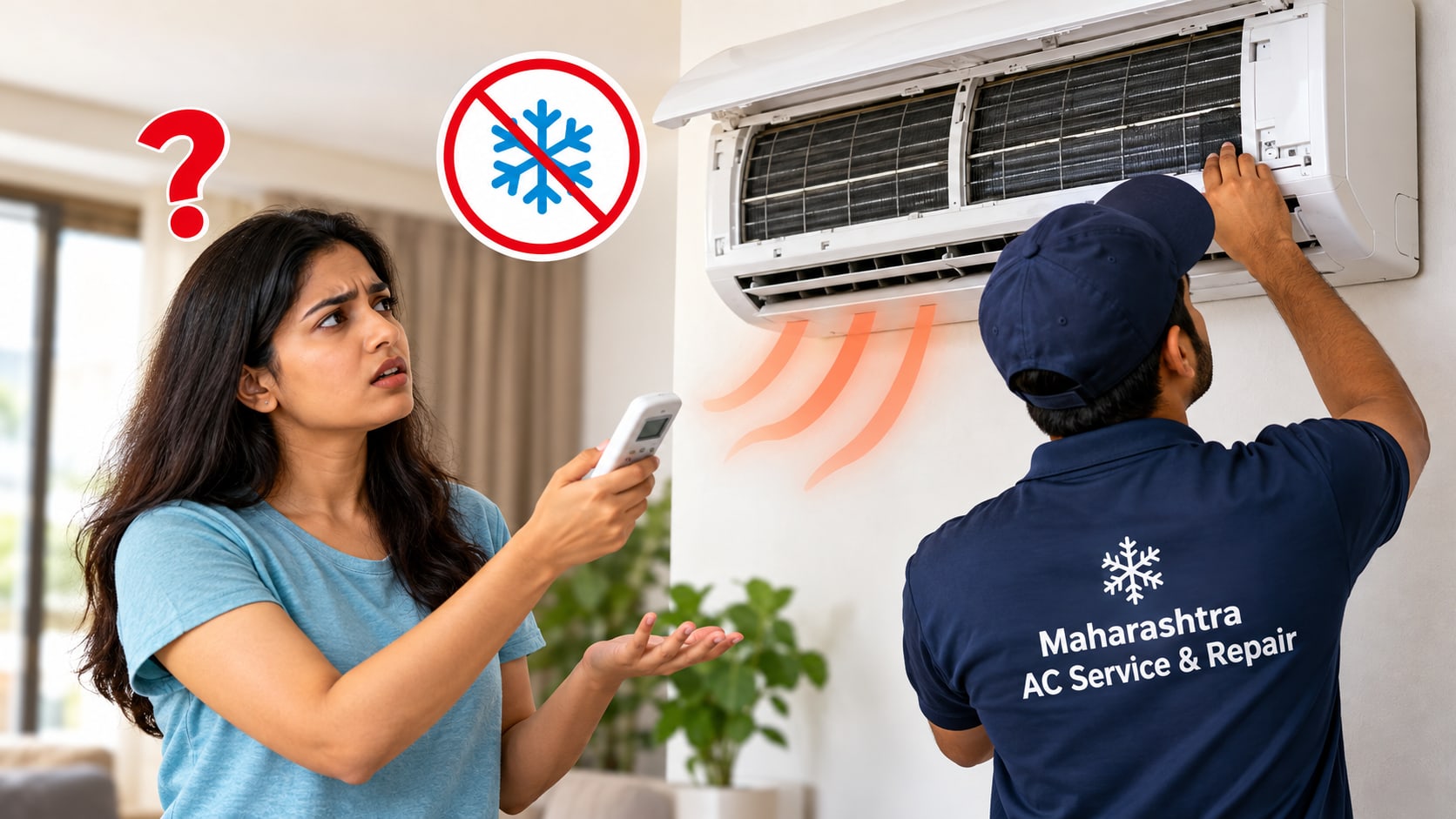
Your air conditioner may be running continuously, but that does not always mean it is cooling your room properly. If your AC is blowing warm air, taking too long to cool the room, or struggling during hot afternoons, there could be a problem with airflow, settings, maintenance, or an internal component.
Understanding why your AC is not cooling can help you identify simple issues and decide when professional repair is necessary. Some problems can be resolved with basic checks, while others require a trained technician to inspect the system.
For homeowners and tenants in Pune and Mumbai, regular AC maintenance is particularly useful during periods of heavy use. Here are 10 common causes of poor AC cooling, along with safe steps you can take to address them.
Quick Answer: Why Is Your AC Not Cooling?
An AC may not cool properly because of a dirty air filter, incorrect thermostat settings, blocked outdoor unit, low refrigerant, frozen evaporator coil, or a faulty component. Check the cooling mode, temperature setting, filter, and airflow first. If cooling does not improve or you notice unusual sounds, leaks, or electrical problems, arrange a professional inspection.
10 Common Reasons Your AC Is Not Cooling
1. Dirty or Clogged Air Filter
A dirty air filter is one of the first things to check when an AC is not cooling properly. Dust and debris collect on the filter over time, restricting airflow through the indoor unit.
When less air passes through the system, your room may take longer to cool. In some cases, restricted airflow can also contribute to ice forming on the indoor coil.
What you can do:
- Switch off the AC before removing the accessible filter.
- Clean a washable filter according to the manufacturer’s instructions.
- Let the filter dry completely before reinstalling it.
- Replace disposable filters when required.
Check the filter regularly, especially if the AC operates for several hours daily or the room collects dust quickly.
2. Incorrect AC Mode or Temperature Setting
Sometimes, the AC is working correctly but has been set to the wrong mode. For example, Fan mode circulates air without providing normal cooling, while Dry mode mainly reduces humidity.
What you can do:
- Set the remote to Cool mode, usually represented by a snowflake symbol.
- Set a reasonable target temperature below the current room temperature.
- Check that the fan is not set to a mode that prevents normal cooling.
- Replace weak remote batteries if the AC does not respond properly.
Allow some time for the room temperature to change. If the unit still blows warm air, investigate other possible causes.
3. Blocked Outdoor Unit
The outdoor unit releases heat collected from inside your room. If dust, leaves, plastic, or other debris obstruct the condenser coil or restrict airflow around the unit, heat removal becomes less effective.
This can reduce cooling performance and place additional strain on the system.
What you can do: Look for visible obstructions around the outdoor unit from a safe position. Keep the surrounding area clear and follow the manufacturer’s clearance recommendations. Do not open the unit, touch electrical components, or attempt to dismantle the coil.
If the coil is heavily clogged, arrange professional cleaning.
4. Low Refrigerant or a Refrigerant Leak
Refrigerant is the substance that transfers heat between the indoor and outdoor units. If the refrigerant level becomes too low because of a leak, the AC may struggle to cool the room.
Possible warning signs include weak cooling, ice on the refrigerant pipes or indoor coil, and longer operating cycles. However, these symptoms can also have other causes, so they do not confirm a refrigerant leak on their own.
Important: AC refrigerant does not normally need to be refilled every year. If the level is low, a technician should inspect the system, locate and repair any leak where present, and recharge it according to the manufacturer’s specifications.
Never attempt to open refrigerant lines or refill gas yourself.
5. Frozen Evaporator Coil
The evaporator coil is the indoor component that absorbs heat from the room. If airflow is restricted or the refrigeration system has a fault, the coil may become too cold and develop ice.
Even when the AC is running, a frozen coil can prevent proper cooling.
Common signs include:
- Ice on the indoor unit or refrigerant pipes.
- Very weak airflow from the vents.
- Water dripping after the ice melts.
- Cooling that becomes worse during operation.
Turn off cooling if you notice ice. If your AC has a separate Fan mode, you may use it to help circulate air while the ice melts, provided there are no electrical warning signs. Do not chip away the ice or use a heater to melt it.
If freezing returns, a technician needs to identify the underlying cause.
6. Dirty Condenser or Evaporator Coils
The coils transfer heat, so dirt covering their surfaces can interfere with heat exchange. The evaporator coil is inside the indoor unit, while the condenser coil is usually part of the outdoor unit.
Dirty filters and dusty surroundings can contribute to this problem, although coil contamination may occur even when the filter looks reasonably clean.
Solution: A technician can inspect the coils and clean them using suitable methods. Avoid spraying water into electrical sections or using harsh chemicals that may damage the equipment.
7. Incorrect AC Capacity for the Room
An AC that is too small for the room may run for long periods without achieving the desired temperature. This can happen when a room is larger than expected for the unit’s capacity or has substantial heat entering through windows, walls, or the roof.
Room size is not the only factor. Ceiling height, sunlight, insulation, occupancy, and heat-producing appliances also affect cooling requirements.
What you can do: Keep curtains closed during strong sunlight, reduce unnecessary heat sources, and ensure doors and windows are closed while cooling. If the problem continues, ask a professional to assess the room’s cooling load before considering a replacement unit.
8. Faulty Compressor or Capacitor
The compressor helps circulate refrigerant through the AC system. A capacitor, where fitted, helps certain motors start or operate.
If either component develops a fault, the indoor fan may continue running while the system provides little or no cooling. Unusual humming, repeated starting attempts, or the outdoor unit failing to operate may indicate a problem.
Solution: Switch off the AC if you notice repeated clicking, abnormal electrical sounds, burning smells, or signs of overheating. Contact a qualified technician for testing and repair. Do not open the electrical panel or handle wiring yourself.
9. Damaged Fan or Weak Airflow
The indoor fan moves cooled air into the room, while the outdoor fan helps release heat. If either fan is damaged, obstructed, or operating incorrectly, cooling performance may suffer.
You might notice unusually weak airflow, grinding noises, or an outdoor unit that does not appear to operate normally.
Check that furniture, curtains, or other objects are not blocking the indoor air outlet. If airflow remains weak or the unit makes unusual noises, professional inspection is recommended.
10. Poor Insulation, Open Windows, or Excessive Heat
Sometimes the AC itself is not faulty. Warm air entering through open windows, gaps around doors, direct sunlight, or a hot roof can make a room difficult to cool.
Frequent opening of doors also allows cooled air to escape. In very hot weather, a room with substantial heat gain may take longer to reach the set temperature.
Practical solutions:
- Close windows and doors while the AC is running.
- Use curtains or blinds to reduce direct sunlight.
- Keep the indoor unit’s air inlet and outlet unobstructed.
- Avoid placing heat-producing appliances near the thermostat.
- Check for obvious gaps around windows and doors.
If these changes do not help, the AC may have an additional maintenance or mechanical issue.
AC Cooling Problems: Symptoms and Possible Causes
Different symptoms can point toward different problems, but they do not provide a definite diagnosis. Use this table to decide what to check next.
| Symptom | Possible cause | Recommended action |
|---|---|---|
| AC blows warm air | Incorrect mode or system fault | Check settings first |
| Airflow is weak | Dirty filter or fan issue | Inspect the accessible filter |
| Ice appears on pipes | Restricted airflow or refrigerant issue | Stop cooling and arrange inspection |
| Outdoor unit is unusually noisy | Fan or compressor problem | Switch off if the noise is abnormal |
| Room stays warm all day | Capacity, heat gain, or maintenance issue | Check room conditions and book an assessment |
| Water leaks indoors | Drainage blockage or melting ice | Seek inspection if leakage is heavy or persistent |
These are possible explanations, not confirmed diagnoses. Several AC faults produce similar symptoms, so a technician may need to test the system to identify the actual cause.
What Should You Check Before Calling an AC Technician?
You can perform a few basic checks without opening the AC or handling electrical parts.
Check the remote settings: Confirm that Cool mode is selected and the target temperature is appropriate.
Inspect the air filter: Clean or replace the accessible filter according to the manufacturer’s instructions.
Check the room: Close windows, reduce direct sunlight, and remove objects blocking airflow.
Look for visible obstructions: From a safe distance, check whether leaves or other objects block the outdoor unit.
If the AC still does not cool after these checks, avoid repeatedly restarting it. Do not remove electrical covers, touch exposed wiring, or attempt refrigerant repairs.
When Should You Call a Professional?
Arrange professional AC repair if the unit continues to blow warm air, repeatedly develops ice, makes unusual noises, or shows signs of a refrigerant or mechanical fault.
Switch off the AC and seek prompt assistance if you notice a burning smell, sparks, smoke, or repeated electrical tripping. If there is smoke or a fire, keep away from the equipment and contact emergency services as appropriate.
A technician can inspect the airflow, coils, drainage, refrigerant circuit, electrical components, and compressor operation as needed. The repair should address the actual cause rather than simply adding refrigerant or replacing parts without diagnosis.
AC Repair and Servicing in Pune and Mumbai
Regular maintenance can help identify dirty filters, blocked coils, drainage problems, and developing faults before they significantly affect cooling. How often servicing is needed depends on usage, dust levels, the environment, and the manufacturer’s recommendations.
For households in Pune and Mumbai, heavy summer use and dusty surroundings can make filter and outdoor-unit checks especially worthwhile. Keep the area around the outdoor unit clear and arrange servicing when performance declines.
Maharashtra AC Service & Repair helps readers looking for AC servicing and repair support in its stated service areas. Before booking, confirm that your locality is covered and ask for an explanation of the inspection and repair charges.
Conclusion
An AC not cooling properly does not always mean the compressor has failed or the system needs refrigerant. Dirty filters, incorrect settings, blocked coils, frozen evaporators, and room heat gain are all possible reasons.
Start with safe checks such as the cooling mode, filter, and room airflow. If cooling remains poor, ice develops, or electrical or mechanical warning signs appear, arrange a professional inspection instead of attempting a risky repair.
For assistance with persistent cooling problems, contact Maharashtra AC Service & Repair and ask about service availability in Pune or Mumbai.
Frequently Asked Questions
1. Why is my AC running but not cooling the room?
Your AC may be running without cooling because of a dirty filter, incorrect settings, restricted airflow, low refrigerant, or a faulty component. Check the basic settings and filter first; arrange an inspection if the problem continues.
2. Does an AC need gas refilling every year?
No, an AC does not normally require annual refrigerant refilling. If the refrigerant level is low, a technician should investigate possible leakage and repair the cause before recharging the system as required.
3. Can a dirty AC filter stop cooling?
Yes, a severely clogged filter can restrict airflow and reduce cooling performance. Clean or replace it according to the manufacturer’s instructions, and check whether cooling improves afterward.
4. Why is my AC blowing air but not cold air?
Your AC may be circulating air without cooling because Fan mode is selected or a refrigeration, compressor, or control-system fault is present. Select Cool mode and seek professional help if the air remains warm.
5. How can I improve AC cooling without repairing it?
You can improve cooling by cleaning the accessible filter, closing windows, reducing direct sunlight, and keeping air outlets clear. If the unit still performs poorly, these steps will not replace the need for proper diagnosis and repair.